
The field of embodied artificial intelligence is moving quickly. New robotic foundation models are demonstrating stronger reasoning, improved instruction following, and increasingly sophisticated physical interactions.
But rapid model development has created another challenge: how do researchers accurately measure what these systems can really do?
A successful demonstration alone is not enough. A robot may perform well in a carefully controlled environment yet struggle when lighting changes, objects move, camera noise appears, or instructions are expressed differently. Without consistent testing standards, comparing models and identifying genuine improvements can be difficult.
RoboColiseum has officially launched to address this challenge.
The platform is a standardized simulation evaluation system built for embodied intelligence. It provides a comprehensive framework for testing robotic models across multiple capabilities and realistic scenarios. The goal is to help researchers understand model performance, identify specific weaknesses, and accelerate the process of improving embodied AI systems.
RoboColiseum is open to universities, research institutions, AI companies, and researchers worldwide. The platform provides standardized benchmarks, detailed evaluation results, capability-specific leaderboards, and continuously developing tasks.
During its closed beta, hundreds of teams from around the world participated in training and evaluating models through the platform.
Learn more about RoboColiseum: http://robocoliseum.ai/
Bringing Simulation Closer to the Physical World
Simulation plays an increasingly important role in robotics research.
Testing every model directly on physical robots can be expensive and time-consuming. Hardware availability, laboratory infrastructure, maintenance, and repeated experiments can all slow down the development process.
Simulation provides a way to conduct large amounts of testing more efficiently. However, its value depends on how closely simulated conditions represent reality.
Real-world robotics involves many variables. Lighting may change from one environment to another. Objects have different textures and physical properties. Cameras introduce imperfections and noise. Robots may begin tasks from different positions or orientations. Interactions between objects can also produce unexpected results.
These differences contribute to the sim-to-real challenge.
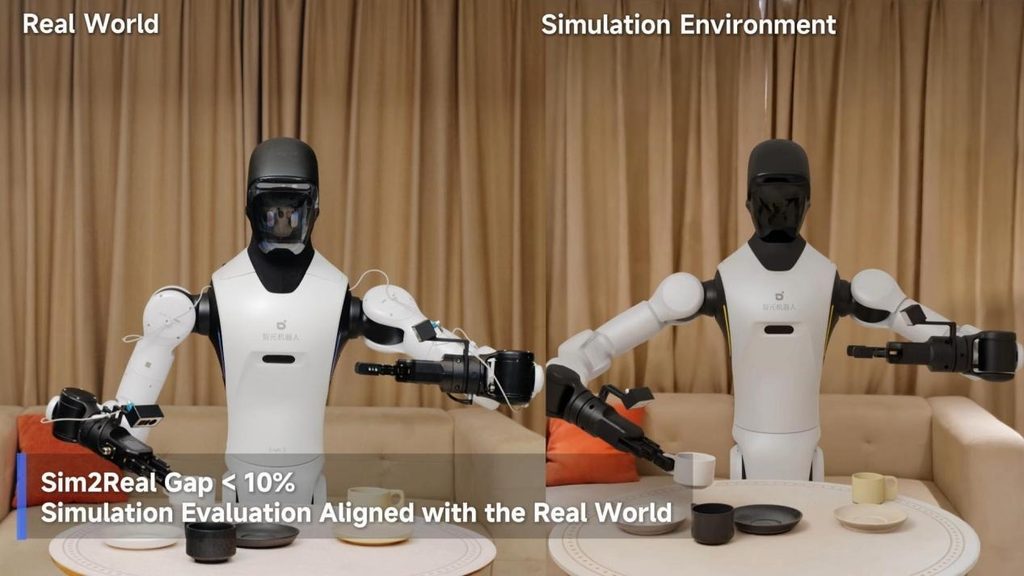
RoboColiseum is designed to reduce this gap through a high-fidelity simulation environment. The platform combines photorealistic rendering with physically accurate interactions to create scenarios that are intended to reflect real-world robotic conditions.
According to RoboColiseum, the platform achieves a sim-to-real gap of less than 10% within its evaluation framework. This alignment is intended to make simulation a useful proxy for physical testing.
For developers, that means more model testing can take place before moving to physical hardware.
A Two-Directional Simulation and Robotics Workflow
RoboColiseum is not limited to models trained in simulation.
Systems trained using real-robot data can also be evaluated inside the simulation environment. This provides researchers with a standardized setting for measuring their capabilities.
Conversely, models trained through simulation can be deployed on physical robots to examine how well their learned abilities transfer to real-world environments.
This creates a two-directional evaluation process that connects simulated and physical development.
The overall workflow can be viewed as:
Train → Evaluate → Analyze → Improve → Validate
Such a process can help developers discover problems earlier and reduce unnecessary physical experiments.
Rather than waiting until the final stage of development to discover that a model struggles with a particular capability, teams can use simulation to identify issues while development is still underway.
Four Capability Areas Provide a Deeper Model Assessment
Embodied intelligence is not a single skill.
A model may be excellent at understanding language but weaker at physical manipulation. Another may have strong spatial reasoning while struggling with environmental changes.
For this reason, RoboColiseum evaluates models across four major dimensions:
Instruction Following
Measures how effectively models understand and execute natural-language instructions.
Spatial Reasoning
Evaluates how well models understand positions, relationships, and spatial arrangements.
Robustness
Tests whether models can maintain performance when environmental and task conditions change.
Manipulation
Measures physical interaction skills and the ability to combine basic actions into more complex sequences.
RoboColiseum currently provides four capability-specific leaderboards and 78 high-fidelity simulation tasks.
This allows developers to evaluate their models at multiple levels instead of relying on one overall success number.
Testing How Well Robots Understand Instructions
Natural-language interaction is becoming an important part of modern robotics.
People should be able to communicate tasks to robots without needing to manually program every movement.
RoboColiseum evaluates instruction following using commands involving attributes such as shape, color, size, object relationships, and logical requirements.
The system measures whether the model’s actions accurately correspond to what it was asked to do.
This can reveal subtle weaknesses.
A model might understand which object a user is referring to but perform an incorrect action. It could also execute a physical action correctly while misunderstanding an important part of the instruction.
By measuring instruction following independently, developers can better identify these limitations.
Evaluating Spatial Understanding
Robots operate in physical environments, so understanding space is fundamental.
RoboColiseum evaluates spatial reasoning through tasks such as relative-position grasping, sorting, and stacking.
These tasks require models to combine visual information with geometric and semantic reasoning.
A robot may need to determine where an object is located, understand its relationship to another object, and select the correct action based on an instruction.
Such scenarios provide a way to measure whether a model genuinely understands spatial relationships instead of simply responding to familiar visual patterns.
Testing Robots Under Unpredictable Conditions
A model’s performance in a controlled environment can sometimes provide an incomplete picture.
Real-world deployment introduces variation.
RoboColiseum addresses this by testing models under more than 10 types of real-world disturbances.
These include changes to lighting, backgrounds, instruction wording, camera noise, gripper configurations, and other environmental factors.
The purpose is to determine whether a model can maintain its capabilities when the conditions surrounding a task change.
This type of testing is particularly important for systems intended to operate outside controlled laboratory environments.
A robust model should not depend entirely on one specific lighting setup, camera configuration, or instruction format.
Measuring Physical Manipulation Skills
Manipulation is central to embodied intelligence.
Robots need to interact with objects in ways that are precise, coordinated, and adaptable.
RoboColiseum measures different atomic manipulation abilities across a range of scenes. These skills are also incorporated into tasks with increasing levels of difficulty.
The platform can therefore examine both basic physical abilities and longer-horizon tasks requiring several actions.
This distinction helps developers understand whether a model struggles with an individual skill or with coordinating multiple skills over an extended sequence.
Understanding Why a Model Fails
A benchmark becomes far more useful when it provides information about failures.
Simply knowing that a robot failed a task does not tell developers what needs to be fixed.
RoboColiseum addresses this by dividing evaluation tasks into multiple subtasks and tracking performance throughout the process.
Researchers can determine which steps were completed successfully and identify where the model encountered difficulties.
This makes evaluation more actionable.
If a model correctly interprets an instruction and identifies the appropriate object but fails while manipulating it, developers can focus on physical interaction rather than language understanding.
Detailed failure information can therefore help teams direct their training resources toward specific weaknesses.
Improving Reliability Through Diverse Evaluation
A strong benchmark must minimize opportunities for models to succeed simply because they have encountered the same environment repeatedly.
RoboColiseum uses large and diverse evaluation samples to reduce this risk.
Its methodology incorporates domain randomization, separate training and testing sets, and both in-distribution and out-of-distribution testing.
These techniques are intended to make evaluations more representative of general model capabilities.
By testing systems under conditions that differ from their training environments, developers can gain more insight into how well their models generalize.
Automated Evaluation Reduces Development Complexity
Building a robotics evaluation system independently can involve substantial technical work.
Teams may need to configure environments, prepare assets, integrate models, manage computational infrastructure, and create evaluation pipelines.
RoboColiseum aims to simplify this process through automated evaluation.
The platform states that developers can register and submit a model in as little as five minutes, deploy it with one click, and complete a simulation evaluation in approximately 30 minutes.
After testing, developers receive detailed scores, task-level results, and model execution videos.
This combination of numerical data and visual evidence can make it easier to understand how a model performs.
Connecting Local Models Through a Standardized Interface
RoboColiseum is designed to support developers who want to maintain their existing model infrastructure.
Model code and weights do not need to be uploaded directly to the platform.
Instead, developers can deploy an inference service locally and connect it to RoboColiseum through a standardized interface.
This allows teams to use the evaluation environment without completely changing their existing development setup.
It can also provide greater flexibility for organizations working with large or proprietary models.
AI Agents Help Streamline the Research Process
The platform also incorporates AI Agent capabilities.
Developers can interact with the system using natural language to perform activities such as downloading data, training models, conducting local validation, and submitting evaluations.
This approach aims to reduce manual effort during common development tasks.
As AI Agents become more capable, natural-language interfaces could make complex technical workflows easier to manage.
RoboColiseum brings this concept into the embodied AI evaluation process.
Comparing New Systems With Leading Baselines
Model evaluation becomes more informative when results can be compared with established systems.
RoboColiseum provides baseline results for several embodied foundation models, including ACoT-VLA, π0, π0.5, and GR00T.
Researchers can compare their own models against these baselines across the platform’s four main capability categories.
This makes it easier to determine where a new system performs competitively and where additional improvements may be required.
Baseline comparisons also give researchers a common reference point when reporting experimental results.
Making Benchmark Results Reproducible
Reproducibility is essential for building confidence in AI research.
When different teams use different evaluation environments and procedures, it becomes difficult to determine whether performance differences are meaningful.
RoboColiseum supports reproducible research by providing training code and corresponding weights for baseline models used on platform tasks.
Researchers can reproduce training and evaluation procedures, verify baseline results, and perform additional experiments under consistent conditions.
This creates a shared foundation for researchers who want to investigate new approaches while maintaining comparable evaluation standards.
An Arena for Testing and a Ground for Improvement
The name RoboColiseum comes from the idea of an arena.
The platform is intended to function as a common testing ground where different embodied AI systems can be evaluated under the same conditions.
But it is also designed as a place for continuous improvement.
Developers can repeatedly test their models, identify weaknesses, make changes, and evaluate new versions.
This transforms benchmarking into an ongoing development process.
Instead of treating evaluation as something that happens only at the end of a project, teams can incorporate it throughout model development.
Encouraging Worldwide Participation
RoboColiseum is open to participants from across the global AI and robotics community.
Universities, research institutions, technology companies, and individual researchers can use the platform to evaluate their models.
The platform also encourages developers to open-source their models and contribute them to the broader ecosystem.
A larger pool of participating models can make benchmark comparisons more valuable while encouraging collaboration between different research communities.
Building a More Transparent Embodied AI Ecosystem
As embodied AI becomes more capable, the need for transparent evaluation will increase.
Researchers need to know whether a model’s improvements are genuine and whether those improvements remain visible when the environment changes.
Companies need ways to determine whether systems are ready for practical deployment.
Developers also need detailed feedback that can guide their next training cycle.
A standardized evaluation environment can help address all three needs.
RoboColiseum’s combination of simulation, multiple capability dimensions, robustness testing, detailed task analysis, and baseline comparisons is designed to provide a broader picture of model performance.
Moving Beyond Carefully Controlled Demonstrations
A robotic model performing a difficult task in a single demonstration can be impressive.
However, real-world intelligence requires more than isolated successes.
A capable embodied AI system should be able to understand instructions, reason about its surroundings, manipulate objects, and adapt to changing conditions.
It should also perform these tasks consistently across different scenarios.
This is why standardized evaluation is becoming increasingly important as embodied AI develops.
RoboColiseum aims to provide an environment where these capabilities can be measured systematically rather than judged primarily through individual demonstrations.
Turning Benchmarking Into Continuous Progress
The ultimate value of evaluation is not simply ranking models.
It is helping developers improve them.
RoboColiseum is designed around a continuous feedback loop in which developers can train a model, evaluate its performance, analyze failures, make improvements, and test the updated system again.
Repeated evaluation can create a measurable record of progress.
Over time, this process can help researchers better understand which techniques produce meaningful improvements and which weaknesses remain difficult to solve.
A Shared Foundation for the Next Generation of Robotics
The launch of RoboColiseum comes at a time when embodied AI is transitioning from research demonstrations toward increasingly practical applications.
As models become more sophisticated, reliable measurement will be essential.
RoboColiseum aims to provide that measurement layer through a combination of high-fidelity simulation, standardized tasks, multi-dimensional evaluation, robustness testing, automated submissions, baseline models, and reproducible research resources.
Its long-term objective is to establish a continuously evolving benchmark that can grow alongside the embodied AI field.
By giving developers a common environment for testing and improvement, RoboColiseum seeks to make progress in embodied intelligence more measurable, transparent, and verifiable.
Rather than focusing only on whether a robot can succeed once, the platform encourages a deeper question: Can the model perform reliably across different tasks, environments, and conditions?
Answering that question will be critical as embodied AI moves closer to widespread real-world deployment.
RoboColiseum is now officially open to developers and researchers worldwide.
Explore RoboColiseum: http://robocoliseum.ai/
