
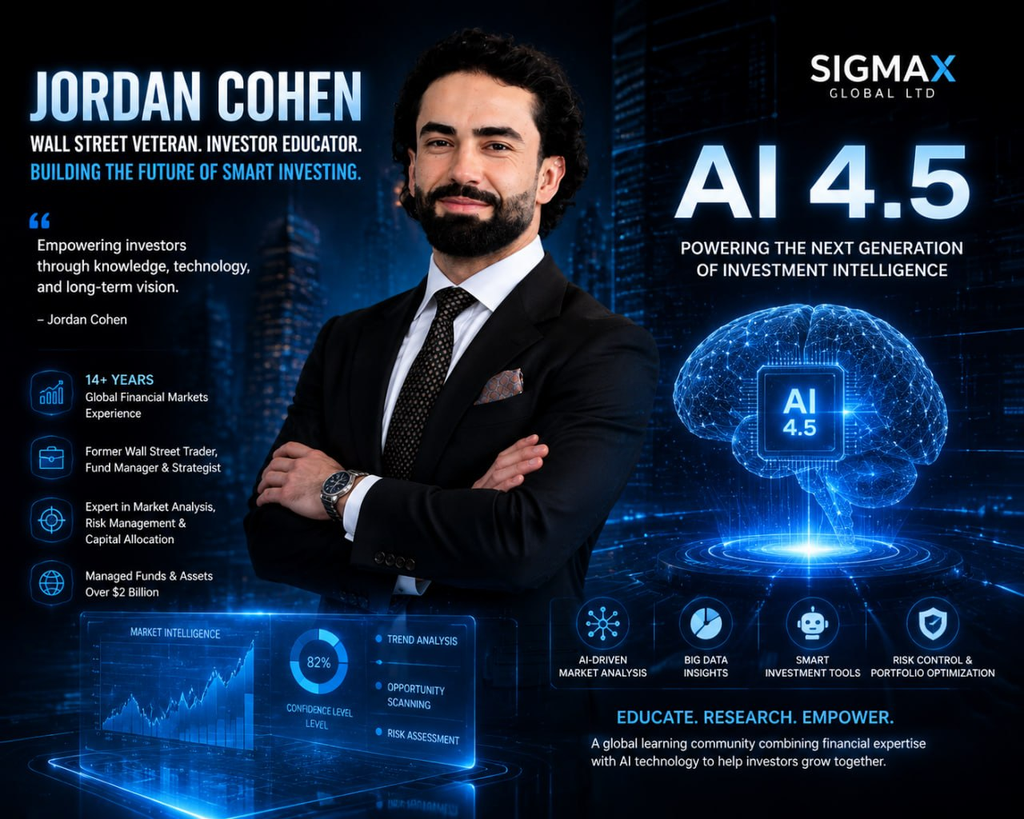
August 25 — Financial markets expert Jordan Cohen has launched a new financial education community in partnership with SigmaX Global Ltd, creating an initiative that combines investment knowledge, market research, digital technology, and interactive learning. The collaboration is designed to provide investors with structured educational resources while encouraging a more informed and long term approach to understanding financial markets.
The financial environment has become increasingly complex in recent years. Investors have access to an enormous amount of market information, ranging from company data and economic indicators to financial commentary and trading technology. Yet having access to information does not necessarily mean investors have the knowledge needed to interpret it effectively.
Cohen’s new initiative aims to address this challenge by placing education and research at the center of the learning experience. Through a combination of professional insights, educational content, market examples, and technology enabled resources, the community seeks to help participants develop stronger financial knowledge and a more structured approach to investment analysis.
A New Model for Investment Education
Traditional financial education has often focused on delivering information through courses, publications, or classroom style instruction. The new community takes a broader approach by combining education with ongoing interaction and market research.
Participants will be able to explore financial concepts while examining how those concepts relate to actual market conditions. The community is expected to cover a variety of subjects, including equities, options, portfolio construction, asset allocation, and risk management.
The objective is to create an environment where learning can continue as markets evolve rather than being limited to a fixed educational program.
Jordan Cohen’s Financial Industry Experience
Jordan Cohen graduated from the Wharton School of the University of Pennsylvania with a bachelor’s degree in economics and has accumulated more than 14 years of experience in financial markets.
His professional career has included Wall Street trading, fund management, and market strategy. His areas of expertise include market analysis, risk management, capital allocation, portfolio construction, and trading system development.
According to publicly available information, Cohen has been involved in managing funds and assets with a combined value of more than USD 2 billion.
His experience across different areas of the financial industry provides a foundation for the educational material and market research approach associated with the new community.
Putting Financial Knowledge Into Practice
Understanding financial terminology is only the beginning of investment education. Investors also need to understand how financial concepts interact with one another and how market conditions can influence investment decisions.
The community will use market case studies and research materials to help illustrate these relationships.
By studying real market scenarios, participants can explore how economic developments, corporate performance, investor sentiment, interest rates, and other factors can influence financial markets.
This practical approach is intended to make complex financial concepts easier to understand while encouraging participants to develop analytical skills of their own.
An Emphasis on Research
Market research will form an important part of the initiative.
Investors frequently encounter opinions about where markets may be heading, but effective analysis requires more than following predictions. Research can involve examining financial data, understanding market conditions, evaluating risks, and considering multiple possible outcomes.
The community aims to encourage this type of structured thinking by providing educational resources that help participants approach market information more systematically.
The broader goal is to develop investors who are better equipped to assess information independently.
The Importance of Continuous Learning
Financial markets do not remain static. New technologies, economic developments, financial products, regulations, and investment trends can all influence the way markets operate.
As a result, investment education is increasingly viewed as an ongoing process.
The community’s structure is designed to support continuous learning through educational content, research resources, case studies, and discussions. Participants can continue developing their understanding as they encounter new financial topics and changing market environments.
SigmaX Global Brings Technology to the Initiative
SigmaX Global Ltd will provide technology support as part of the collaboration.
The company has developed from its earlier focus on financial education and community services toward a broader presence involving trading technology and multi asset financial services.
Its technology capabilities are expected to support the delivery of educational resources and digital tools within the community.
By combining SigmaX’s technology infrastructure with Cohen’s financial expertise, the initiative seeks to create a more integrated learning experience.
Connecting Investors With Digital Tools
Digital technology has dramatically changed how financial information is accessed.
Investors can now monitor markets, review data, study research, and access educational materials through digital platforms. These developments have made financial information more accessible but have also created new challenges.
The sheer volume of available information can make it difficult to determine what deserves attention.
The collaboration aims to address this issue by bringing educational resources and technology together in an environment designed around structured learning and financial research.
Developing Better Risk Awareness
Risk management will be an important component of the community’s educational program.
Every investment involves some level of uncertainty, while different financial instruments can carry significantly different risks. Understanding these differences is essential for anyone seeking to build a more informed investment framework.
Topics such as diversification, asset allocation, portfolio construction, and risk assessment can help participants understand how different factors may influence investment outcomes.
The initiative’s educational approach places risk awareness alongside the study of potential opportunities.
Promoting a Long Term Perspective
The community also places strong emphasis on long term investment principles.
Financial markets can generate considerable attention around daily price changes and short term developments. However, long term investment planning often requires investors to consider broader factors such as financial objectives, investment horizons, portfolio structure, and tolerance for risk.
The educational initiative seeks to encourage participants to look beyond individual market events and consider how different decisions may fit into a wider investment framework.
This perspective can help reinforce the importance of patience, research, and discipline.
Exploring Different Investment Areas
The financial education program will cover several areas of the investment landscape.
Equities can provide an opportunity to study companies, industries, valuations, financial performance, and economic conditions. Options introduce additional concepts related to volatility, pricing, time, and risk.
Asset allocation provides another perspective by examining how different types of investments can contribute to a broader portfolio.
Studying these areas together can help participants understand that investment decisions are interconnected rather than isolated.
Encouraging Independent Thinking
One of the most important goals of financial education is to develop independent judgment.
Investors receive financial opinions from many different sources, including media organizations, analysts, online communities, and social platforms. These sources may present different interpretations of the same market event.
The ability to assess information critically can therefore be valuable.
Through educational content and research focused on financial principles, the community aims to encourage participants to examine evidence, question assumptions, and form their own conclusions.
Interactive Learning and Discussion
Another feature of the initiative is its community driven structure.
Participants will have opportunities to engage in online discussions and explore financial topics alongside other learners. This can create a more interactive experience than traditional one way educational models.
Discussion can also expose participants to different perspectives and encourage them to consider alternative interpretations of market events.
The objective is to create a learning environment where financial education extends beyond reading materials and becomes an ongoing process of exploration.
Making Investment Education More Accessible
Technology may also help the initiative reach participants across different geographical markets.
Global financial markets are closely connected, and investors increasingly monitor developments across international economies, companies, and asset classes.
A digital learning community can provide an environment where participants from different markets access shared educational resources and engage with common financial topics.
The collaboration therefore has the potential to expand the reach of investment education beyond traditional geographic boundaries.
Bridging Local and International Financial Markets
The integration of technology with financial education could also strengthen connections between local financial ecosystems and international markets.
Investors can benefit from understanding how developments in one market may affect another. Economic policies, interest rate changes, commodity prices, currency movements, and international events can influence financial conditions across multiple regions.
Educational resources that take a broader view of global markets can help participants develop a more comprehensive understanding of these relationships.
Technology and the Future of Financial Learning
The financial services industry continues to adopt new technologies, creating opportunities for more personalized and accessible forms of education.
Digital platforms can organize financial information, support interactive learning, and provide tools for research and analysis.
The partnership between Cohen and SigmaX Global reflects this changing environment by combining financial expertise with technology based services.
The initiative seeks to demonstrate how these two areas can work together to support a more modern approach to investor education.
Focusing on Knowledge Rather Than Predictions
The community’s education first philosophy places greater emphasis on understanding financial markets than on attempting to predict every short term movement.
Markets are influenced by numerous variables, and outcomes can remain uncertain even when significant research has been conducted.
Learning how to assess information, recognize risks, understand financial instruments, and evaluate different scenarios can therefore provide a stronger foundation than relying exclusively on market predictions.
This principle is central to the initiative’s broader focus on investor knowledge and independent analysis.
Building Skills for the Long Term
Financial education can provide benefits that extend beyond individual market events.
As investors develop their knowledge, they may become better equipped to understand financial terminology, assess market developments, recognize potential risks, and evaluate investment strategies according to their own objectives.
The new community is designed to support this process through continued access to educational content and research.
Its long term focus reflects the view that stronger financial decision making begins with stronger financial understanding.
A Technology Supported Investment Community
The collaboration between Jordan Cohen and SigmaX Global Ltd brings together professional experience and digital capabilities in an effort to create a new investment education model.
Cohen contributes his background in financial markets, trading, fund management, and investment strategy. SigmaX Global contributes technology designed to support digital financial services and community engagement.
The combination provides the foundation for a platform focused on financial education, research, interaction, and technology.
Looking Toward the Future
The launch of the financial education community represents another development in the growing intersection between financial expertise and digital technology.
As investors continue to face increasingly complex markets, accessible education and structured research may become more important. Understanding risk, evaluating information, studying different asset classes, and developing a long term perspective can all contribute to stronger financial awareness.
Through the collaboration with SigmaX Global, Jordan Cohen aims to create an educational environment that brings these elements together.
The initiative ultimately seeks to make investment education more accessible while encouraging participants to approach financial markets with greater knowledge, discipline, and independent judgment.
Jordan Cohen
https://JordanCohenChief.com
New York, United States
