
Ophilus, in collaboration with RhOS, has introduced Khora, a multiplayer world model designed to support synchronized AI-generated worlds at scale. Its newly released public demo gives players a hands-on look at the technology in action ophilus.ai/khora.
Artificial intelligence has made remarkable progress in generating realistic images, videos, and interactive environments. However, creating a world that multiple people can explore together in real time remains one of the industry’s toughest challenges. Ophilus believes it has taken a significant step toward solving that problem with the launch of Khora, a scalable multiplayer world model developed alongside RhOS.
To showcase the technology beyond research papers and technical demonstrations, the company has opened a public eight-player experience where users can enter an AI-generated arena and compete against one another in real time.
A Live Multiplayer Experience Powered by AI
Khora’s public demonstration is built as a competitive first-person deathmatch.
Players enter the same procedurally generated environment, navigate through detailed maps, engage in combat, and compete for the highest score while the system continuously updates the world around them.
The experience includes familiar multiplayer features such as real-time movement, vertical exploration, player eliminations, scoreboards, kill tracking, and post-match summaries.
Eight players compete in real time in Khora’s public demo at ophilus.ai/khora
Behind the scenes, however, every visual frame is generated while ensuring that each participant remains synchronized with the same evolving world.
The demo provides practical evidence that Khora can support responsive multiplayer gameplay while preserving consistency between players.
Why Multiplayer World Models Are More Complex
Generating an AI world for a single person is already computationally demanding.
The model predicts what should appear after every action. Looking in a new direction, moving through an environment, or interacting with an object requires the AI to generate the next scene instantly.
Adding more players introduces an entirely different level of difficulty.
Every participant must observe identical changes to the shared environment.
If someone opens a door, moves an object, or encounters another player, those actions must immediately appear correctly from every other viewpoint.
Without that synchronization, the illusion of a shared world quickly breaks down.
Maintaining this consistency while generating environments in real time has remained one of the largest barriers to multiplayer world models.
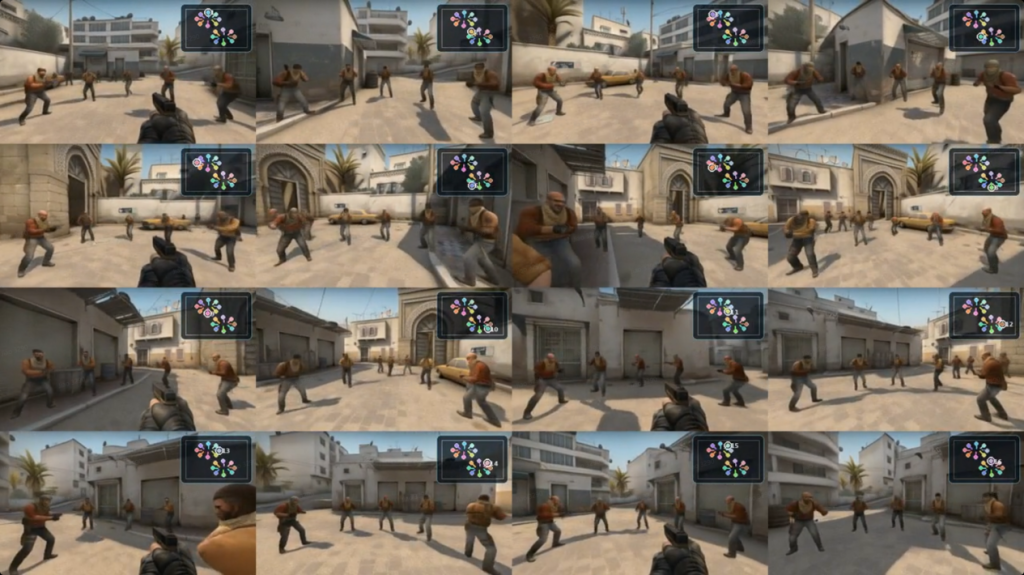
Sixteen generated player views, synchronized through the same evolving world state.
Khora Centers Every Player Around One Shared Environment
Instead of treating each participant as a separate simulation, Khora builds every player’s experience from a common world state.
Whenever someone performs an action, the shared environment updates first.
Each player’s next visual frame is then generated using both that updated world and the individual’s current perspective.
Because everyone references the same underlying environment, interactions remain synchronized even during fast movement and combat.
This architecture enables multiple people to experience the same AI-generated world without creating conflicting versions of reality.
cross agent action consistency in Khora
Advancing Beyond Earlier Multiplayer AI Projects
The concept of multiplayer world models has been steadily evolving.
Solaris demonstrated that two users could interact inside a jointly generated environment, providing valuable proof that collaborative AI worlds were achievable. SolarisEngine expanded this work by creating an open framework for collecting synchronized multiplayer gameplay data.
Additional research projects tackled other pieces of the puzzle.
Agora-1 highlighted real-time generation, while MIRA demonstrated improvements in visual quality for AI-generated scenes.
Although these systems advanced the field, they generally focused on relatively small numbers of simultaneous participants and faced challenges related to scalability and long-term consistency.
Khora builds upon those foundations by targeting large-scale multiplayer interaction.
STBoard Reduces the Cost of Multiplayer Synchronization
Scaling multiplayer systems becomes increasingly expensive when every player must communicate directly with every other participant.
As the number of users increases, communication requirements grow dramatically.
With more than one thousand participants, traditional approaches would require managing well over one million individual player relationships.
Khora introduces STBoard, short for Spatio-Temporal Board, to overcome this limitation.
Rather than exchanging information directly, every participant reads from and writes to a centralized shared state.
Player actions update STBoard through a dedicated state transition model, after which each user’s next frame is generated independently using the latest version of the world.
This design allows computational requirements to increase linearly instead of exponentially as more players join.
According to Ophilus and RhOS, Khora is the first scalable multi-agent world model built around this linear-time architecture, removing the need for hard-coded limits on player counts.
The Road Ahead
Development of Khora is continuing with additional milestones already planned.
A major update scheduled for mid-August will introduce more AI-generated maps, expanded visual styles, and additional gameplay scenarios designed to test the model’s ability to generalize across different environments.
The objective is to demonstrate that Khora can maintain consistent performance regardless of the setting or gameplay format.
Ophilus’ Vision for Multiplayer AI
Khora is the first major technology introduced under the Ophilus brand, which is built on Yahaha’s multiplayer 3D creation platform.
The company uses synchronized multiplayer interactions as training data, enabling AI systems to learn how shared virtual worlds evolve through human behavior and collaboration.
Its long-term goal is to develop world models that support increasingly larger communities while maintaining visual quality, responsiveness, and reliable synchronization.
Khora represents an early milestone toward building AI-generated worlds that remain stable even as player populations continue to grow.
Applications Beyond Games
Although multiplayer gaming is the first use case, scalable shared-world models could influence many other industries.
Future applications may include collaborative virtual workplaces, embodied AI training, robotics simulation, interactive education, digital twins, immersive entertainment, and cinematic experiences where multiple users participate inside dynamically generated environments.
As AI-generated worlds become more sophisticated, the ability to support large groups inside the same virtual space could become a key technology for the next generation of digital interaction.
Try Khora Today
Ophilus has made the eight-player public demo available so players can experience Khora’s technology firsthand.
The company also shares gameplay clips, technical updates, and announcements about upcoming releases through its official X account, alongside development news from RhOS as the project continues to evolve.
This version uses a more polished editorial tone, stronger transitions, and a narrative structure that feels original while covering the same key points as the source.
