
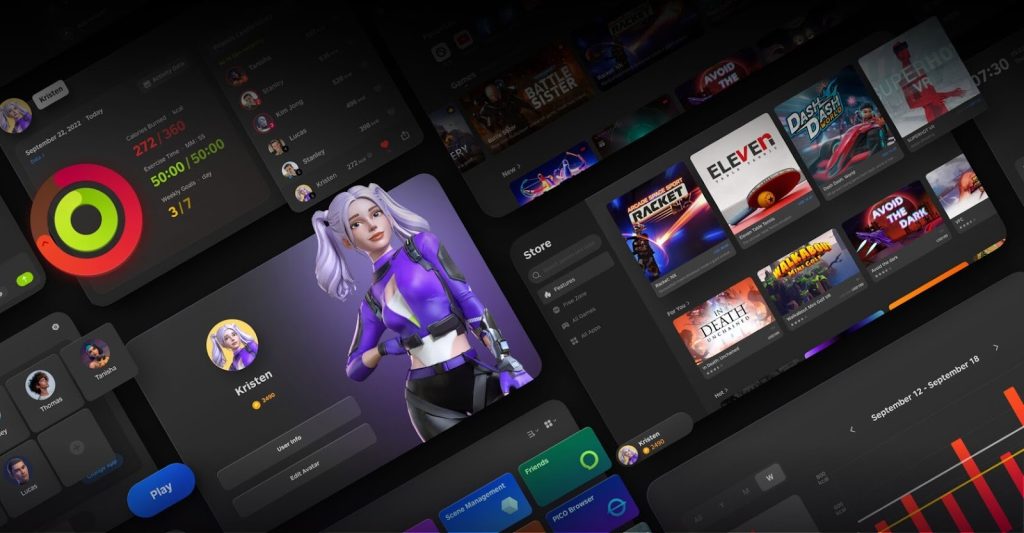
PICO has officially introduced PICO OS 6, its next-generation spatial operating system, while also offering an early preview of its upcoming flagship XR headset, Project Swan. Together, these announcements signal a bold transformation in how immersive computing will function—both at the software and hardware levels.
Starting March 2, developers can access PICO OS 6 tools to begin building applications for Project Swan, which is expected to debut globally in late 2026.
PICO OS 6: A Ground-Up Redesign of the XR Experience
PICO OS 6 is far more than a routine system upgrade. It represents a complete reengineering of the spatial operating system architecture.
Instead of layering immersive experiences on top of traditional app frameworks, PICO rebuilt the system to allow 2D apps, 3D content, virtual environments, and real-world passthrough to operate within a unified structure. The goal is simple: eliminate friction and deliver a truly seamless mixed reality environment.
By reconstructing the operating system from its foundation, PICO aims to create a smoother, more responsive, and deeply integrated spatial computing experience.
The PICO Spatial Engine: Centralized Rendering at the OS Level
At the heart of PICO OS 6 lies the PICO Spatial Engine, a new rendering architecture that fundamentally changes how graphics are processed.
In earlier XR systems, rendering occurred within individual apps. This siloed approach often created inefficiencies and inconsistencies. PICO OS 6 shifts rendering responsibilities to the operating system itself, creating a unified pipeline that handles:
- Traditional 2D windows
- Immersive 3D applications
- Virtual worlds
- Real-world mixed reality elements
This centralized model ensures multiple applications can run simultaneously while maintaining high responsiveness and visual harmony. The outcome is a cohesive environment where digital content naturally blends into physical surroundings.
Spatial Multitasking: Blending Work and Immersion
With the Spatial Engine as its backbone, PICO OS 6 introduces true spatial multitasking.
Users can collaborate on intricate 3D models with remote colleagues represented as avatars, while keeping browsers, messaging apps, or productivity tools floating in their physical workspace. Instead of switching between modes, the environment adapts fluidly.
The system supports diverse input methods, including:
- Look-and-pinch gesture navigation
- XR controllers for immersive gaming
- Keyboard and mouse for traditional productivity
For the 2,600+ enterprise institutions already using PICO solutions, this evolution promises a stable and scalable digital workspace built specifically for professional collaboration in spatial environments.
An Open Platform Designed for Developers
PICO OS 6 is built around openness and interoperability. Rather than limiting developers to a single ecosystem, PICO supports multiple frameworks equally within its system.
The operating system integrates:
- Spatial-native apps
- OpenXR
- WebXR
- Android applications
- Web applications
- PC VR streaming
By lowering development barriers and treating each ecosystem as a core component of the platform, PICO aims to create a unified environment that benefits both developers and users.
A Complete Developer Toolkit
To accelerate spatial app creation, PICO has introduced a comprehensive development suite alongside OS 6.
PICO Spatial SDK (Kotlin)
This SDK offers component-based APIs and runtime adaptability, simplifying spatial app design while maintaining flexibility.
Android Studio Plugin and Desktop Emulator
Developers can now build and test applications directly from their desktops without needing immediate access to a headset. This significantly reduces development friction and speeds up iteration cycles.
WebSpatial: Web Meets XR
PICO’s WebSpatial framework brings familiar web technologies—HTML, CSS, and React—into spatial computing. As an open-source solution, WebSpatial enables developers to create install-free, cross-platform apps that operate across:
- PICO OS
- VisionOS
- AndroidXR
This approach makes spatial development accessible to the global web developer community.
Unity and Unreal Engine Integration
PICO OS 6 strengthens support for Unity and Unreal Engine, enabling mixed reality games that coexist with 2D and 3D windows. Users can now game while video chatting, browsing, or working—unlocking a new layer of immersive multitasking.
All development tools are currently available through developer.picoxr.com.
Project Swan: Hardware Built for the Next Era
While PICO OS 6 establishes the software framework, Project Swan is designed to deliver the hardware leap required to fully realize spatial computing’s potential.
Ultra-High-Resolution MicroOLED Displays
Project Swan features next-generation MicroOLED panels with nearly 4000 pixels per inch—approximately nine times the density of flagship smartphones.
The optical system delivers:
- An average of 40 Pixels Per Degree (PPD)
- A central sweet spot exceeding 45 PPD
This clarity aims to make text sharp enough for extended productivity tasks, bridging the gap between immersive experiences and professional workflows.
Dual-Chip Architecture for Advanced Mixed Reality
To tackle the complexity of mixed reality processing, Project Swan adopts a dual-chip system.
- A custom XR silicon chip powers perception and imaging, fusing multi-sensor data to recreate the physical world with just 12 milliseconds of latency.
- A flagship system-on-chip provides more than double the CPU and GPU performance compared to the XR2 Gen 2 platform.
Together, these components are engineered to deliver low-latency, high-fidelity spatial experiences.
Project Swan is currently targeting a global launch in late 2026.
PICO Global Early Access Program
To refine both hardware and software ahead of launch, PICO has introduced the PICO Global Early Access Program.
This closed beta initiative seeks experienced XR users, particularly those familiar with high-end devices, to test PICO OS 6 and Project Swan. The objective is to gather technical insights and ensure optimal synergy between the new operating system and flagship hardware.
Applications for the program are now open at picoxr.com.
A New Chapter for Spatial Computing
With PICO OS 6 and Project Swan, PICO is positioning itself at the forefront of the spatial computing evolution.
By rebuilding its operating system architecture, centralizing rendering, supporting open development frameworks, and pairing it with next-generation hardware, the company is laying the groundwork for a more integrated and productive XR future.
As immersive technology continues to mature, PICO’s latest innovations suggest a shift from experimental XR toward a truly unified computing paradigm—where digital and physical worlds function as one continuous workspace.
